Airbag Warning Light: Meaning and Causes
When the airbag light stays on, your airbags may not deploy in a crash. Here is what usually triggers the SRS warning, how shops diagnose it and how to check for open airbag recalls.
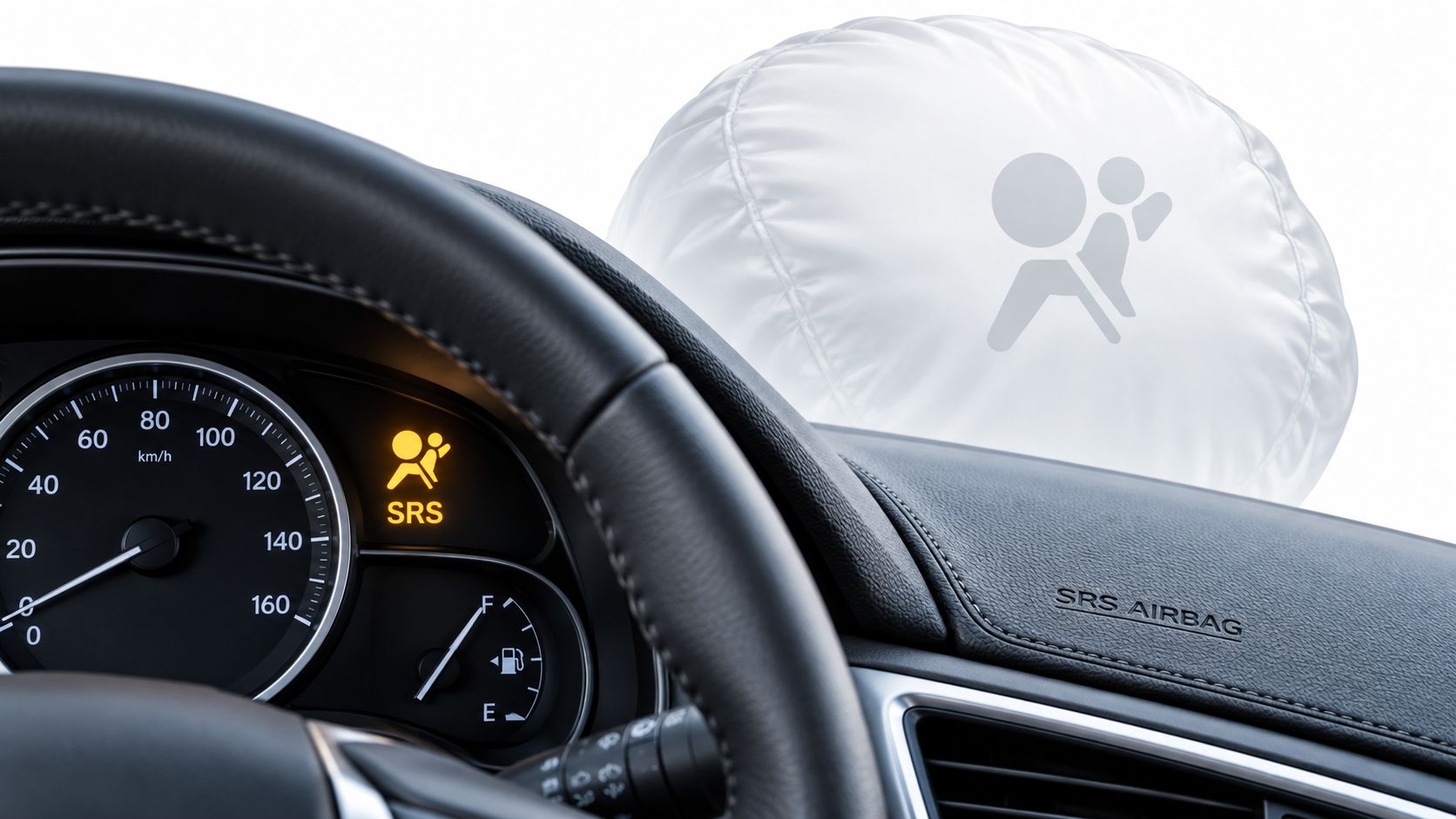
An airbag warning light that stays on means the car's supplemental restraint system (SRS) has detected a fault and has likely disabled some or all of the airbags until it is repaired. The car will drive normally, but in a crash the airbags and seat belt pretensioners may not work as designed. The most common causes are a failed clock spring in the steering column, damaged connectors under the front seats, faulty seat occupant or seat belt sensors, and low battery voltage. Get it diagnosed promptly, and check your VIN for open airbag recalls at the same time.
What the SRS light is supposed to do
When you start the car, the airbag light should come on for a few seconds while the airbag control module runs a self-check, then turn off. If it stays on, comes on while driving, or flashes, the module has found a problem and stored a fault code. On many vehicles, the system then disables the affected airbag or the whole system, because deploying with a known fault could be unpredictable.
The SRS includes more than the bags themselves: crash sensors, the control module, seat belt pretensioners, seat belt buckle switches, the passenger occupant classification sensor and all the wiring and connectors between them.
Common causes
Clock spring
The clock spring is a coiled ribbon cable inside the steering column that keeps the driver airbag, horn and steering wheel buttons connected while the wheel turns. It can wear or break, especially on higher-mileage vehicles. Classic signs are the airbag light plus a horn that does not work, or steering wheel buttons such as cruise control or audio controls that stop responding.
Seat connectors and wiring
Front seats contain side airbags, seat belt pretensioners and sensors, and their wiring runs under the seat. Connectors can loosen or corrode, and wires can get pinched when the seat moves or when something is stuffed under it. On some vehicles this is a well-known source of intermittent airbag lights. Never probe or unplug airbag connectors with the battery connected.
Occupant classification and buckle sensors
The front passenger seat has a sensor that decides whether the occupant is an adult, a child or nothing, so the system can turn the passenger airbag on or off. A faulty sensor, or a heavy bag or car seat, can confuse it. Seat belt buckle switches can also fail.
Low voltage
A weak battery or a recent jump start can log an SRS fault. Sometimes the light clears after the voltage problem is fixed; sometimes the code must be cleared with a scan tool. See our guide to battery drain and electrical problems if the battery keeps dying.
Previous deployment or collision repair
After a crash where airbags deployed, the module stores crash data and must be replaced or reset, and deployed parts replaced. A light that stays on after collision repair can mean the job was incomplete, which is a serious red flag on a used car.
Aftermarket seats, steering wheels or seat covers
Seat covers that block side airbags, aftermarket steering wheels and removed seats can all trigger faults or prevent proper deployment.
Diagnosis
Many basic OBD-II code readers cannot read airbag codes. Shops use scan tools that communicate with the airbag control module to retrieve specific SRS codes, such as a high resistance in the driver airbag circuit or a fault in a seat belt pretensioner. That points them to the right circuit. Because airbags contain explosive charges, repairs should be done by trained technicians following the manufacturer's procedures.
Repair costs vary widely. A connector cleaned and secured under a seat may be a small labor charge, while a clock spring, occupant sensor or airbag module replacement costs more because of parts and the time needed to remove the steering wheel or seat. Ask the shop for the exact SRS code and its explanation before approving work, and ask whether a recall or warranty extension covers the part.
Is it safe to drive with the airbag light on
The car will run, steer and brake normally. The risk is what happens in a crash: one or more airbags may not deploy, and seat belt pretensioners may not tighten. That is a significant reduction in protection. Schedule a repair soon, and in the meantime make sure everyone wears a seat belt and children ride in the back seat in proper restraints. Many state safety inspections fail a vehicle with an illuminated airbag light.
Airbag recalls
Airbag systems have been the subject of some of the largest recalls in automotive history.
- Takata inflators. Certain Takata inflators can degrade with age, heat and humidity and then rupture during deployment, sending metal fragments into the cabin. The recall covered tens of millions of inflators across many brands and is the largest auto safety recall in US history. Deaths and injuries have been linked to the ruptures, and NHTSA has urged owners of certain older vehicles not to drive them until they are repaired.
- ARC inflators. NHTSA has pushed for a recall of a very large number of inflators made by ARC Automotive, following ruptures. Some automakers have issued recalls for specific vehicles.
- Clock springs, sensors and wiring. Many smaller recalls cover components that can cause the airbag light to come on or prevent deployment.
An airbag recall does not always turn on the warning light. A Takata inflator, for example, can be dangerous with no warning at all. That is why you should check every car by VIN. Owners have filed 1,987 complaints with NHTSA about the 2003 Honda Accord, and the 2003 Accord air bag complaints and 2003 Accord recalls pages show how Takata affected older Hondas. The 2001 Civic recalls page lists another heavily recalled model year. Our recalls hub covers recent campaigns across all makes.
Recall repairs are free at the dealer, regardless of the vehicle's age or how many owners it has had. Some automakers will even arrange mobile repair or provide a loaner for dangerous airbag recalls.
Buying a used car with an airbag light on
Treat it as a major question mark. It can be a $100 connector repair or a sign of a past crash with incomplete repairs. Ask for a scan of the SRS codes before purchase, check the vehicle history for collisions, and confirm all airbag recalls are complete. If the seller says "it just needs a sensor," get that confirmed in writing by a shop before you pay.