Phantom Braking: When Automatic Emergency Braking Hits the Brakes for Nothing
Automatic emergency braking prevents crashes, but false activations can cause them. Here is why phantom braking happens, which investigations NHTSA has opened and what drivers can do.
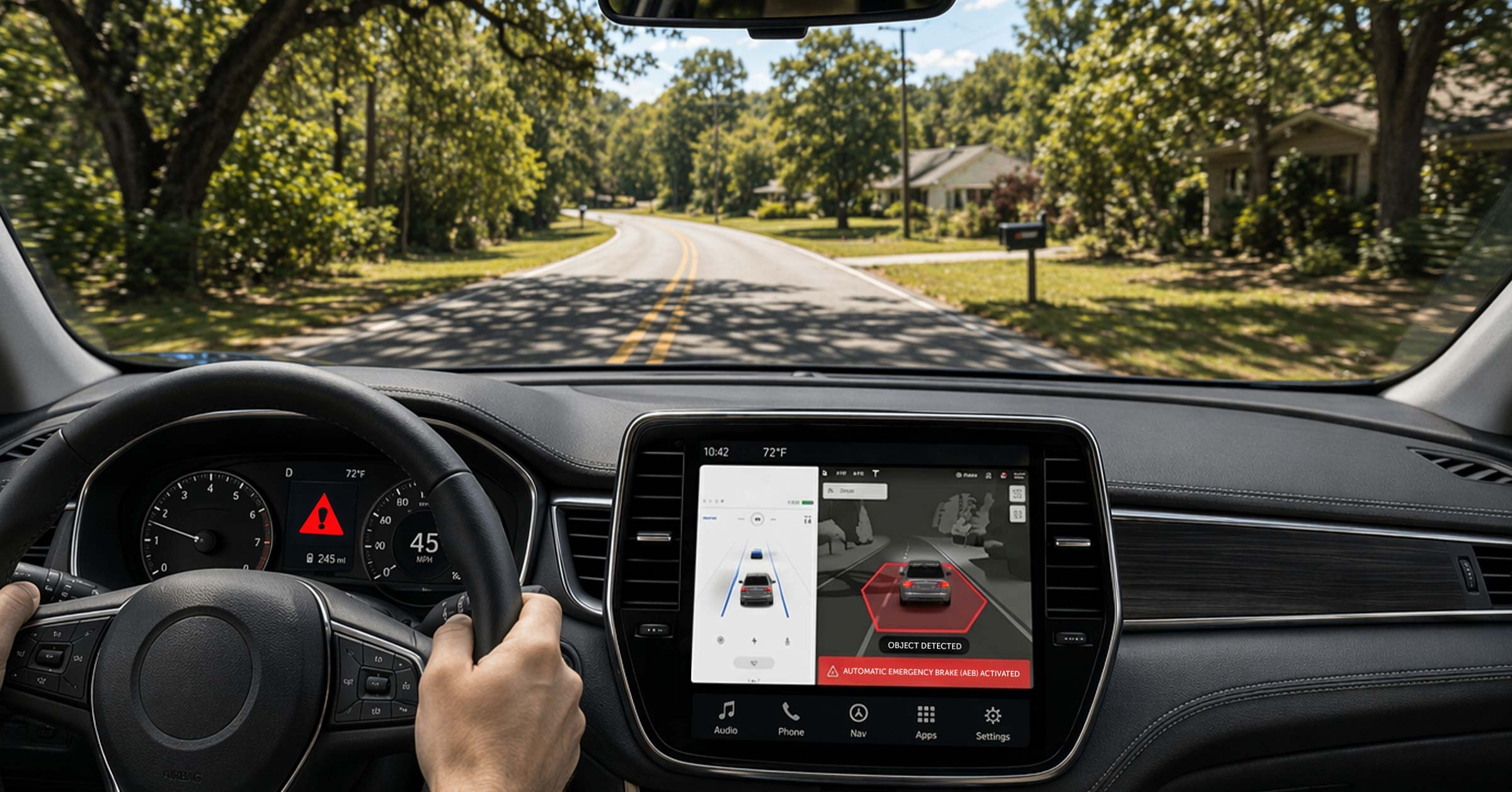
Phantom braking is when a car's automatic emergency braking (AEB) or adaptive cruise control brakes hard for a hazard that is not there. It often happens at highway speed, under an overpass, near a shadow or when passing a truck in the next lane. A sudden slowdown from 70 mph with traffic behind you is dangerous, and NHTSA has opened investigations into false braking on several popular vehicles. If it happens to you, document it, get the sensors checked and file a complaint.
What automatic emergency braking does
AEB uses forward-facing sensors to watch the road ahead. Depending on the vehicle, those sensors are a camera behind the windshield, a radar unit behind the grille or bumper, or both. If the system decides a collision is likely and the driver has not reacted, it first warns the driver and then applies the brakes.
The safety case for AEB is strong. Research from the Insurance Institute for Highway Safety has found that it significantly reduces rear-end crashes. NHTSA finalized a rule in 2024 that will require AEB, including pedestrian detection, on new passenger cars and light trucks by September 2029. Most new vehicles already have it.
The challenge is the threshold. A system tuned to brake early will catch more real hazards and also produce more false alarms. A system tuned conservatively produces fewer false alarms but may react late. Every automaker is making that tradeoff, and software updates often shift it.
What causes false activations
- Overpasses and bridges. Radar can read a large stationary structure as an obstacle, especially on a curve or a grade.
- Shadows and lighting. Camera-based systems can misread sharp shadows, low sun or glare.
- Vehicles in adjacent lanes, particularly large trucks or cars turning off the road, on curves where they appear to be in your path.
- Roadside objects such as signs, guardrails, metal plates or parked cars on a curve.
- Dirty or blocked sensors. Snow, ice, mud, bugs or a damaged bumper cover can confuse radar. A cracked or replaced windshield can affect cameras.
- Misalignment. After a minor collision or windshield replacement, sensors may need recalibration. Skipping calibration is a common cause.
- Software logic. Some false activations come from how the system interprets sensor data, which only the manufacturer can change.
Adaptive cruise control versus AEB
Owners use the term phantom braking for two different events. One is a full automatic emergency braking activation, usually with a loud alert and very hard braking. The other is adaptive cruise control slowing abruptly because it misjudged a vehicle or object ahead, which is often less violent but more frequent. Both rely on the same forward sensors, but they are separate functions with separate settings. When you report the problem, say which system was active. That helps the dealer reproduce the issue and helps investigators separate patterns.
NHTSA investigations
NHTSA has opened several investigations into unexpected braking. In early 2022 it opened a preliminary evaluation into 2021 and 2022 Tesla Model 3 and Model Y vehicles after hundreds of reports of unexpected braking at highway speed. Owners have filed 674 complaints with NHTSA about the 2021 Tesla Model 3 and 1,095 about the 2021 Model Y. The 2021 Model 3 driver assist complaints and 2021 Model Y problems pages show many of these reports.
Tesla is not alone. NHTSA has also looked into false AEB activations on other high-volume models, including the Nissan Rogue and certain Honda Accord and CR-V model years, following owner complaints. Owners have filed 2,163 complaints with NHTSA about the 2018 Honda CR-V and 671 about the 2018 Nissan Rogue; see the 2018 CR-V problems and 2018 Rogue problems pages. Investigation status changes over time, and opening an investigation is not a finding of a defect. Check NHTSA for the current status of any probe.
Some false braking issues have been addressed through recalls or software updates, including over-the-air updates on vehicles that support them.
What to do if your car phantom brakes
- Stay calm and keep control. If the car brakes for nothing, pressing the accelerator usually overrides the system on most vehicles. Check your manual for how yours behaves.
- Note the details right away. Date, time, speed, location, weather, what was nearby, and any message on the dash. A dashcam clip is very useful.
- Clean the sensors. Check the windshield area in front of the camera and the radar location in the grille or bumper.
- Think about recent repairs. Windshield replacement, bumper repair or an alignment can all affect calibration. Ask the shop whether calibration was performed.
- Take it to the dealer with your notes. Ask them to check for stored codes, verify calibration and install any software updates.
- Check for recalls on your VIN.
Many vehicles let you adjust forward collision warning sensitivity or temporarily disable AEB through a menu. That may reduce false alerts, but you also lose a feature that prevents real crashes. If you change settings, understand what you are giving up, and note that most systems switch back on each time you start the car.
How to file a complaint
NHTSA's investigations into phantom braking began with owner complaints, so reports matter. File at NHTSA's Report a Safety Problem page. Be specific: speed before and after, how hard the car braked, whether a crash or near miss occurred, whether you were using adaptive cruise or driving manually, and what the dealer found. Choose a category that fits, typically forward collision avoidance or the closest driver assistance option. Reading other owners' reports on the problem pages for your model year can help you describe the pattern clearly, and our guide on reading NHTSA complaint data explains how those reports are used.
Also tell the automaker directly through its customer care line. A case number on file helps if the issue later becomes a recall or if you pursue a warranty or lemon law claim.
Is phantom braking a reason to avoid a car
For most buyers, no. The rate of false activations varies widely by model and software version, and AEB prevents a large number of real crashes. But if a specific model year shows a heavy cluster of driver assist complaints, take a long highway test drive with adaptive cruise on, pass trucks, go under overpasses and see how the car behaves before you buy.